Wear safety footwear
Instructs the reader to wear safety footwear.
Understanding this sign
Blue circular signs communicate an action, such as wearing eye protection or following a specified procedure.
A pictogram does not select the grade of PPE or explain a complete procedure. Use the task-specific instructions.
What Counts as Compliance With M008
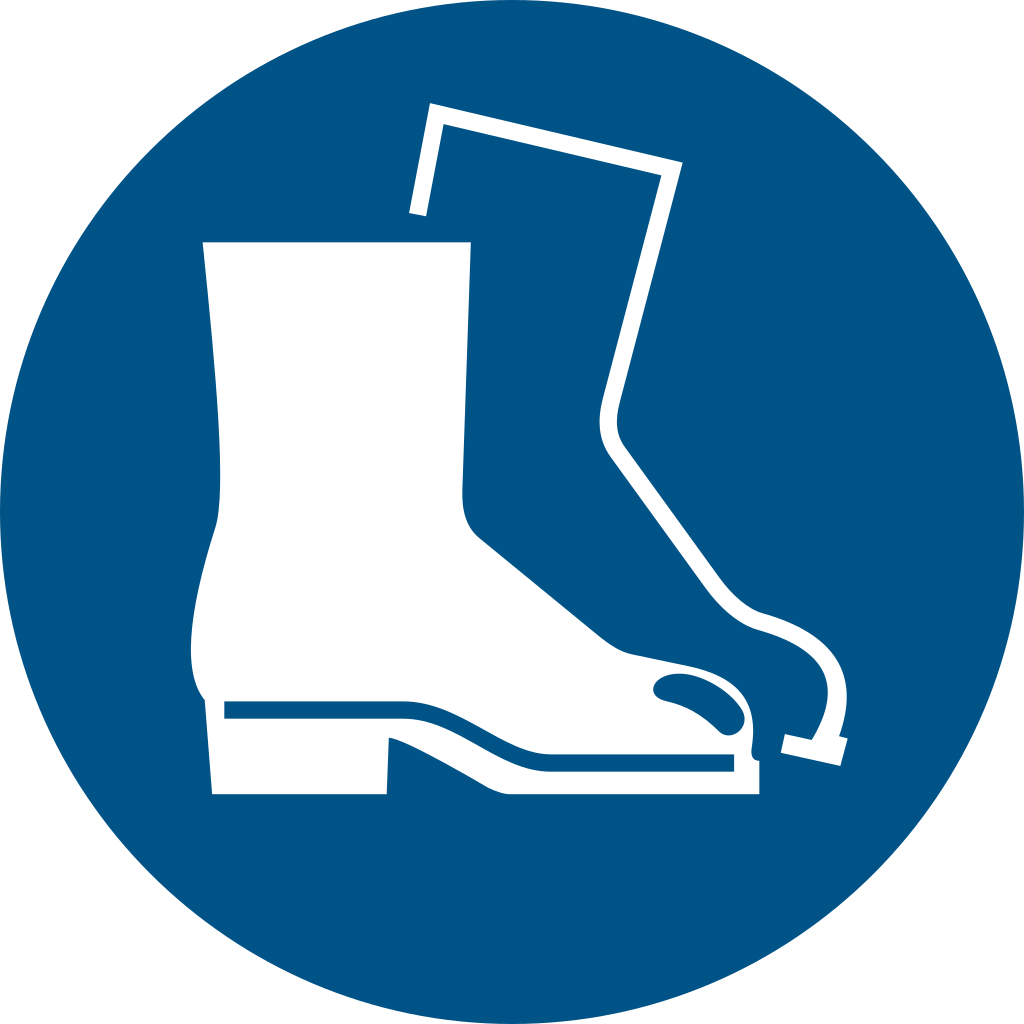
M008 tells everyone past the sign to be wearing safety footwear — footwear built with protective features such as a protective toe cap, and depending on the specification, midsole penetration resistance, slip-resistant soling, or antistatic properties. The pictogram, a white boot inside the blue mandatory circle, marks the start of a footwear-controlled zone: from that line onward, trainers, office shoes, and worn-out site boots no longer meet the entry condition, regardless of how briefly someone intends to stay.
Unlike gloves or goggles, footwear cannot be put on at the door, which changes how the sign functions in practice. M008 works less as a point-of-use prompt and more as an access-control notice: it tells visitors, drivers, and contractors at the gatehouse or warehouse entrance that they cannot proceed without proper boots, and it justifies turning them back or issuing loaner footwear. Sites that treat it as a reminder rather than an entry condition end up with delivery drivers in sneakers standing under suspended pallets.
The Hazards and Rules Behind the Sign
OSHA's foot protection standard, 29 CFR 1910.136, requires protective footwear where there is danger of foot injuries from falling or rolling objects, from objects piercing the sole, or where feet are exposed to electrical hazards. Those three mechanisms map directly onto the places M008 is posted: warehouses and loading docks (falling cartons, pallet-truck wheels), construction and demolition sites (nails and debris underfoot), and steel service centers or foundries where dropped stock is a daily possibility. The employer's PPE hazard assessment under 1910.132 determines which areas the rule covers.
The equipment side is defined by consensus standards. In the US, 1910.136(b) points to ASTM F2413, whose marked codes cover impact and compression resistance plus optional properties like puncture resistance and electrical-hazard rating. In Europe, EN ISO 20345 governs safety footwear and requires a toe cap tested to 200 joules of impact, with S-classes (S1, S3, and so on) bundling additional features. Under PPE Regulation (EU) 2016/425 safety footwear is CE-marked, and Directive 92/58/EEC supplies the blue circular sign format that makes the zone rule visible.
Drawing the Zone Boundary
Post M008 where the footwear rule genuinely begins: the pedestrian gate to a construction site, the door from offices into the warehouse or production floor, the top of the stairs into a basement plant room, and yard entrances used by visiting drivers. Because compliance requires having arrived in the right boots, the most effective placements are early — gatehouse signage, delivery booking instructions, and visitor induction material — with the physical sign at the boundary serving as the final, enforceable line.
Two placement mistakes recur. The first is marking the whole facility when only part of it carries foot hazards; forcing safety boots in areas with no falling-object or puncture risk breeds resentment and casual violations that bleed into the zones that matter. The second is ignoring mixed-traffic transitions, such as a canteen or smoking area reachable only through the production floor — either reroute the pedestrian path or accept that the footwear rule applies to the journey and sign it accordingly. Boundaries should follow the hazard assessment, not the building outline.
Specifying the Right Footwear Class
The M008 pictogram does not distinguish between a basic toe-cap shoe and a fully specified boot, so the site PPE matrix has to. A parcel warehouse may only need impact and compression protection, while groundworks crews need penetration-resistant midsoles (S3 under EN ISO 20345, or the puncture-resistance marking under ASTM F2413), and electricians may need electrical-hazard-rated soles. Where a specific class is mandatory, print it as supplementary text under the symbol — "Safety footwear S3 minimum" — so the sign specifies a verifiable requirement instead of a vague one.
Related signs are worth distinguishing. ISO 7010 M021, which requires antistatic footwear for electrostatic-sensitive or ATEX areas, addresses a conductivity requirement that ordinary safety boots may not meet, so an electronics assembly line or solvent room may need M021 rather than, or in addition to, M008. Chemical process areas that hose down floors sometimes need protective boots with chemical-resistant uppers, again a property the basic pictogram cannot convey. When in doubt, the sign states the behavior and the PPE specification beneath it states the standard the boot must meet.
Where you will see M008
It belongs at pedestrian gates to construction sites, doors from offices into warehouses or production floors, stairs into basement plant rooms, and yard entrances used by visiting drivers. Warehouses and loading docks post it against falling cartons and pallet-truck wheels, while steel service centers, foundries, and demolition sites rely on it where dropped stock and nails underfoot are daily possibilities.
Common questions about M008
Are steel toe boots required by law in warehouses?
US law does not name warehouses specifically; OSHA 1910.136 requires protective footwear wherever the employer's hazard assessment finds a risk of falling or rolling objects, sole punctures, or electrical hazards. Almost any warehouse with racking, pallet trucks, or manual handling meets that test, which is why blanket safety-footwear rules marked with M008 are the industry norm. The cap does not have to be steel — composite and aluminum caps meeting ASTM F2413 or EN ISO 20345 are equally compliant.
What does S3 mean on safety footwear?
S3 is a class under the European standard EN ISO 20345. It combines the baseline 200-joule toe cap with a closed heel, antistatic properties, energy absorption in the heel, water-resistant uppers, and a penetration-resistant midsole. If an M008 sign carries supplementary text requiring S3, ordinary S1 shoes without midsole protection do not satisfy it — typical on construction sites and anywhere sharp debris ends up underfoot.
Do visitors and delivery drivers have to comply with a safety footwear sign?
Yes — the M008 sign binds everyone crossing the boundary, and site operators retain duties toward non-employees in the marked area. Practical options are keeping a stock of loaner safety boots or overshoe toe protectors at reception, escorting visitors along a designated safe walkway that stays outside the footwear zone, or refusing floor access. Escorted-walkway arrangements only work if the walkway is genuinely outside the falling-object risk area, not just painted on the same floor.
Who pays for safety footwear, the employer or the worker?
In the US, OSHA's payment rule (29 CFR 1910.132(h)) requires employers to provide most PPE at no cost, but it contains a specific exception for non-specialty safety-toe footwear that the employer allows workers to wear off-site — that footwear can be employee-paid. Specialty footwear that stays on site must be employer-funded. In the EU, employers must provide necessary PPE free of charge under the workplace PPE framework.
Reference details
| Symbol code | M008 |
|---|---|
| Sign family | ISO Mandatory Signs |
| Standard reference | ISO 7010:2019 / ISO 3864-1 ISO Online Browsing Platform: M008 |
| Screen color reference | #0000FF. Screen colors are not a production color specification. |
| Download formats | SVG reference artwork; a 1024 × 1024 pixel PNG conversion on a white canvas. |
| Record date | · How to interpret our dates |
| Page updated |
Choosing a physical sign size
Download dimensions are not installation dimensions. Select sign size, material, placement, and lighting using the applicable standard and the actual viewing conditions. Chemical label sizing follows its own rules. Read the artwork and sizing guide.
Sources and artwork credits
- Artwork source
- Wikimedia Commons file page
- Creator credited by source
- ISO
- License
- Public domain
- Source metadata checked
SVG files are local reference copies. PNG files are raster conversions. Check the linked file history and license terms before reuse; a source-metadata check is not certification of the artwork or a workplace installation.
Report a correction to this reference