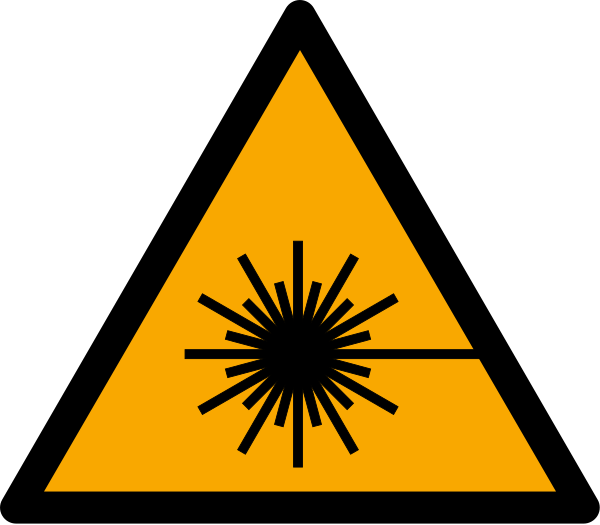
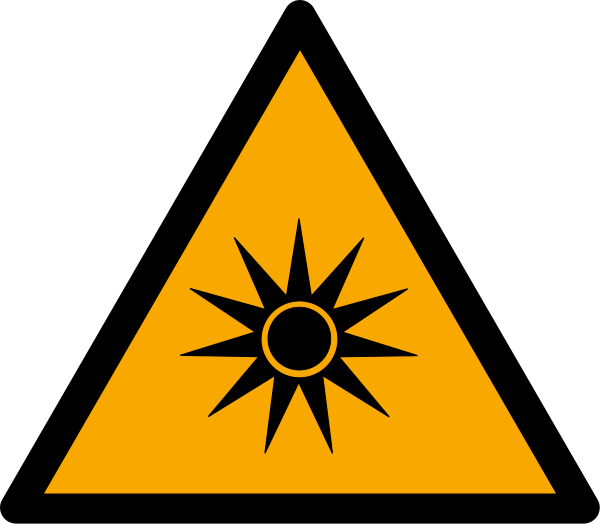
Opaque eye protection must be worn
Instructs the reader to wear opaque eye protection.

Understanding this sign
Blue circular signs communicate an action, such as wearing eye protection or following a specified procedure.
A pictogram does not select the grade of PPE or explain a complete procedure. Use the task-specific instructions.
Why Opaque, Not Just Protective
M007 tells the viewer that eye protection blocking light completely — not impact-rated clear lenses — is required beyond this point. That single word, opaque, carries the entire meaning. Clear safety spectacles stop chips and splash but transmit visible and near-visible light freely, so they do nothing against an intense optical source. M007 exists for situations where the eye must be shielded from the radiation itself: fully covering goggles, moulded eye cups, or padded eye masks that let no light reach the cornea and retina.
The sign therefore appears around strong artificial optical radiation rather than mechanical hazards. Typical settings include sunbeds and UV tanning equipment, UV curing and germicidal lamp installations, intense pulsed light (IPL) treatment rooms, and phototherapy units. In many of these, the person the sign protects is not an operator at all but a client or patient lying under the source, which changes how and where the sign should be posted.
M007 in Laser and IPL Environments
Laser and IPL facilities draw a useful distinction that M007 captures well. An operator who must see the treatment site wears filtered protective eyewear rated for the specific wavelengths in use — such eyewear attenuates the beam but remains partly transparent. A patient or bystander inside the controlled area has no need to see, so the safer option is total blockage: opaque goggles or metal eye cups that eliminate the exposure question entirely. Cosmetic laser and IPL clinics routinely issue opaque patient eyewear for exactly this reason.
M007 consequently pairs with the warning signs for the source: W004 (laser beam) at laser controlled areas and W027 (optical radiation) where broadband sources like UV lamps or arc systems operate. Posting the warning identifies the hazard; adding M007 converts it into a concrete instruction at the door of the treatment room, curing cabinet enclosure, or lamp test bay.
Choosing Between M007 and Other Eye Signs
Confusing M007 with M004 is the most common specification error. M004 calls for conventional eye protection against particles, dust, and splash — its wearers keep full vision. If workers in the area still need to see to do their job, M004 with supplementary text naming a filter grade, or a laser-specific instruction, is usually more appropriate than M007. Reserve M007 for zones or moments where eyes should be covered outright.
Two neighbouring codes complete the family. M019 covers welding masks, whose auto-darkening or fixed shade filters are again transmissive by design, not opaque. M025 is the direct infant counterpart of M007, created for neonatal phototherapy where a newborn's eyes must be covered during blue-light jaundice treatment. A hospital phototherapy suite might legitimately display both: M025 for the infant's eye mask and M007 for adults working close to the light source.
Where you will see M007
Sunbed and UV tanning installations, UV curing and germicidal lamp bays, intense pulsed light treatment rooms, and phototherapy units are its natural homes, often protecting clients or patients lying under the source rather than operators. Cosmetic laser and IPL clinics issue opaque patient eyewear inside controlled areas, and the sign pairs with W004 or W027 warnings at treatment room doors and lamp test bays.
Common questions about M007
How is M007 different from the M004 eye protection sign?
M004 requires standard eye protection — clear or lightly tinted impact- and splash-rated eyewear that the wearer can see through. M007 requires opaque protection that blocks light entirely, which is only sensible where intense optical radiation is the hazard and the protected person does not need vision, such as clients under sunbeds or patients during IPL and laser treatments.
Where is the opaque eye protection sign actually used?
Most commonly in tanning salons and solaria, cosmetic laser and IPL clinics, phototherapy areas, UV curing and germicidal lamp installations, and lamp or optics test facilities. In these settings the sign frequently addresses patients and visitors rather than trained staff, so it is placed at treatment room doors and on the equipment itself.
Do laser safety glasses satisfy an M007 sign?
Not strictly. Laser protective eyewear uses wavelength-specific filters and remains partly transparent so operators can work; it is protective but not opaque. M007 calls for eyewear that admits no light, such as moulded eye cups or full-blackout goggles. If your risk assessment shows operators need filtered rather than opaque eyewear, the signage should say that explicitly instead of relying on M007 alone.
Which warning sign goes together with M007?
Pair it with the sign that names the source: W004 for laser beams and W027 for optical radiation from UV, infrared, or intense visible-light equipment. The warning triangle tells people what the danger is; M007 tells them the specific action — covering the eyes completely — required before entering or starting treatment.
Reference details
| Symbol code | M007 |
|---|---|
| Sign family | ISO Mandatory Signs |
| Standard reference | ISO 7010:2019 / ISO 3864-1 ISO Online Browsing Platform: M007 |
| Screen color reference | #0000FF. Screen colors are not a production color specification. |
| Download formats | SVG reference artwork; a 1024 × 1024 pixel PNG conversion on a white canvas. |
| Record date | · How to interpret our dates |
| Page updated |
Choosing a physical sign size
Download dimensions are not installation dimensions. Select sign size, material, placement, and lighting using the applicable standard and the actual viewing conditions. Chemical label sizing follows its own rules. Read the artwork and sizing guide.
Sources and artwork credits
- Artwork source
- Wikimedia Commons file page
- Creator credited by source
- ISO
- License
- Public domain
- Source metadata checked
SVG files are local reference copies. PNG files are raster conversions. Check the linked file history and license terms before reuse; a source-metadata check is not certification of the artwork or a workplace installation.
Report a correction to this reference