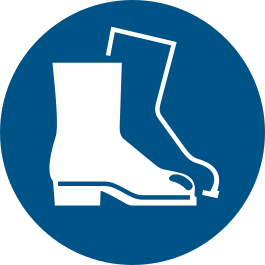
Wear ear protection
Instructs the reader to wear hearing protection. The pictogram does not specify an exposure threshold or protector rating.

Understanding this sign
Blue circular signs communicate an action, such as wearing eye protection or following a specified procedure.
A pictogram does not select the grade of PPE or explain a complete procedure. Use the task-specific instructions.
What M003 Requires
M003 makes hearing protection compulsory from the point where the sign is posted. The blue circle with a white pictogram of a head wearing earmuffs follows the mandatory-action format of ISO 3864-1: unlike a warning sign, it does not merely flag noise as a hazard, it instructs every person crossing that line to have earplugs or earmuffs correctly fitted. The obligation covers everyone entering the zone — operators, maintenance staff, cleaners, and visitors — for the entire time they remain inside it, not just while a specific machine is running.
The pictogram shows earmuffs, but the sign is equipment-neutral. It is satisfied by any hearing protector that reduces the wearer's exposure to an acceptable level: disposable foam plugs, reusable banded plugs, passive earmuffs, or level-dependent electronic muffs. Which device is adequate depends on the measured noise level and the protector's attenuation rating, which is why M003 should always be backed by a noise assessment rather than posted on instinct.
Noise Levels That Trigger the Sign
In the United States, OSHA's occupational noise standard (29 CFR 1910.95) sets an 8-hour time-weighted-average action level of 85 dBA, at which a hearing conservation program with audiometric testing begins, and a permissible exposure limit of 90 dBA TWA, above which feasible controls and hearing protection are required. Employers typically post M003 or an equivalent mandatory sign at the boundary of any area where exposures reach these levels, so the rule is enforced by geography rather than by individual dosimetry alone.
In the EU, the noise directive (2003/10/EC) works in steps: at the lower action value of 80 dB(A) daily exposure, employers must make hearing protectors available; at the upper action value of 85 dB(A), wearing them becomes mandatory and areas should be marked and access restricted. That 85 dB(A) mandatory threshold is exactly where M003 signage belongs, and Directive 92/58/EEC requires the marking to use the blue circular mandatory format that M003 implements.
Where to Post It on Site
Define the hearing protection zone from noise-mapping data and post M003 at every entry point to it: doorways into compressor rooms, generator enclosures, stamping and forging halls, bottling lines, sawmills, and test cells. The sign must be readable before a person's ears are inside the zone, so mount it on the approach side of the door or gate. For task-based noise — such as using a chipping hammer or angle grinder in an otherwise quiet shop — a smaller M003 label on the machine or at the workbench is often more accurate than zoning an entire room.
A frequent mistake is posting M003 only at the main production entrance while noisy plant rooms deeper in the building — chiller plants, air handling rooms, pump skids — go unmarked, even though occasional visitors like electricians face the highest unprotected exposures there. Another is leaving signs up after machinery is replaced with quieter equipment; a sign that no longer matches measured noise erodes compliance with every M003 on site. Re-check zone boundaries whenever the noise survey is updated.
Choosing Protectors and Related Signage
The sign obliges the worker; the employer must supply protectors that actually bring exposure down to a safe level. In Europe, hearing protectors are certified under EN 352 and, because harmful noise causes irreversible damage, they fall into Category III of PPE Regulation (EU) 2016/425 — the highest conformity-assessment tier. In the US, protectors carry an EPA Noise Reduction Rating (NRR); OSHA's guidance derates the labeled NRR when estimating real-world protection, so do not select devices on the label value alone.
M003 covers hearing only. Loud areas usually carry compound risks, so it commonly appears alongside M014 (head protection) and M004 (eye protection) on multi-symbol PPE boards at plant entrances. Where noise is extreme enough that double protection — plugs worn under muffs — is required, the standard M003 pictogram does not communicate that; add supplementary text stating the double-protection rule, because a worker in foam plugs will otherwise reasonably believe the sign is satisfied.
Where you will see M003
Compressor rooms, generator enclosures, stamping and forging halls, bottling lines, sawmills, and test cells post it at every entry point, mounted on the approach side of the door so it is read before a person's ears are inside the zone. Smaller M003 labels mark individual machines for task-based noise such as chipping hammers or angle grinders, and the sign commonly appears with M014 and M004 on multi-symbol PPE boards at plant entrances.
Common questions about M003
At what noise level is hearing protection legally required?
Under OSHA 1910.95, hearing protection must be made available at an 8-hour average of 85 dBA and exposure must be controlled at the 90 dBA permissible exposure limit; workers who have shown a standard threshold shift, or lack a baseline audiogram, must wear protection from 85 dBA. In the EU, protectors must be provided at 80 dB(A) daily exposure and their use becomes mandatory at 85 dB(A). Site rules are often stricter, and the posted M003 sign is binding regardless of what any individual dosimeter reads that day.
Do earplugs or earmuffs satisfy the M003 sign?
Either can, provided the attenuation is sufficient for the measured noise in that zone. The pictogram happens to show earmuffs, but ISO 7010 defines the referent simply as wear ear protection. Check the site's PPE specification: some zones with very high levels require earmuffs specifically, or plugs and muffs worn together, and that requirement should be spelled out in supplementary text under the sign.
Does everyone have to wear hearing protection in a marked zone, even for a few seconds?
Yes. The M003 sign applies to anyone inside the zone boundary for any duration. Although hearing damage is dose-based, area rules are deliberately written as absolute because brief-visit exceptions are unenforceable in practice and short visits in very loud areas can still contribute meaningful dose. If a corridor route forces people through a marked zone, the better fix is rerouting or enclosure, not an exception.
What is the difference between the M003 sign and a noise warning sign?
A warning sign (yellow triangle) tells you a noise hazard exists; M003 (blue circle) orders a specific behavior — putting on hearing protection before entry. Many sites use both: the warning at the perimeter of a high-noise plant and M003 at each doorway where the wearing obligation actually begins. Only the blue mandatory sign creates the enforceable PPE rule.
Reference details
| Symbol code | M003 |
|---|---|
| Sign family | ISO Mandatory Signs |
| Standard reference | ISO 7010:2019 / ISO 3864-1 ISO Online Browsing Platform: M003 |
| Screen color reference | #0000FF. Screen colors are not a production color specification. |
| Download formats | SVG reference artwork; a 1024 × 1024 pixel PNG conversion on a white canvas. |
| Record date | · How to interpret our dates |
| Page updated |
Choosing a physical sign size
Download dimensions are not installation dimensions. Select sign size, material, placement, and lighting using the applicable standard and the actual viewing conditions. Chemical label sizing follows its own rules. Read the artwork and sizing guide.
Sources and artwork credits
- Artwork source
- Wikimedia Commons file page
- Creator credited by source
- ISO
- License
- Public domain
- Source metadata checked
SVG files are local reference copies. PNG files are raster conversions. Check the linked file history and license terms before reuse; a source-metadata check is not certification of the artwork or a workplace installation.
Report a correction to this reference