Fire blanket
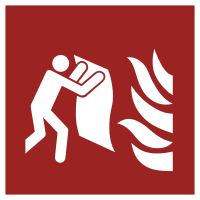
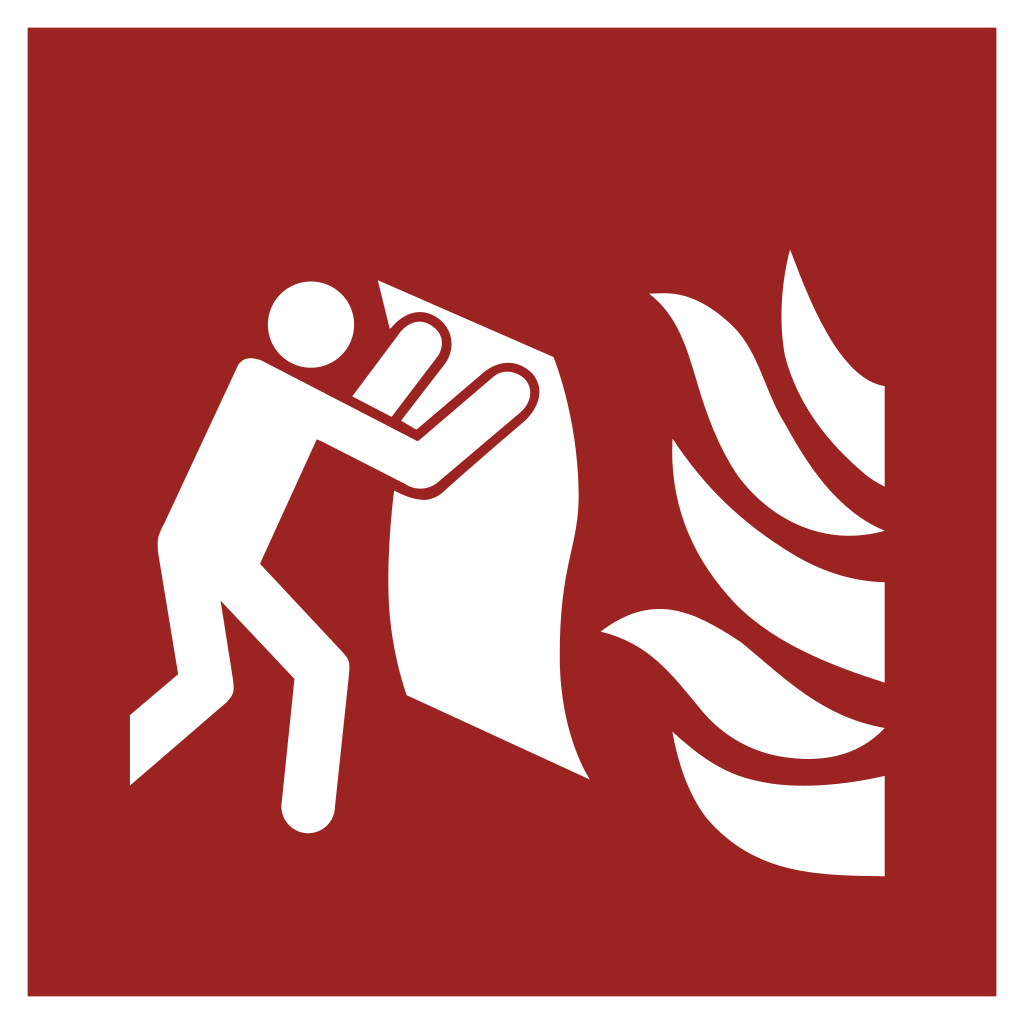
Identifies a fire blanket.
Understanding this sign
Red square or rectangular signs identify fire equipment and manual alarm points.
Finding equipment does not mean it is suitable or safe to use. Follow your training and the site emergency procedure.
The Simplest Tool in the F-Series
F016 shows where a fire blanket is kept: a sheet of fire-resistant fabric, typically woven glass fiber, stored folded in a quick-release container mounted on the wall. Pulled out by its tapes and laid over a small fire, the blanket extinguishes by smothering — it cuts the flames off from air and holds the seal while the fuel beneath cools. No pressure, no agent, no mess, and no skill beyond a briefing.
That simplicity defines its niche. A blanket works only on fires it can completely cover: a pan or small container of burning fat or oil, a wastebasket, a small appliance, or clothing alight on a person. It offers nothing against a fire larger than itself, which is why blanket points complement rather than replace extinguishers.
Kitchens, Labs, and Clothing Fires
Commercial and domestic kitchens are the blanket's home ground, because burning cooking fat punishes almost every alternative — water causes a violent eruption of flaming oil, and even a poorly aimed extinguisher can splash the fuel out of the pan. A blanket laid gently over the vessel, working away from the user's hands, seals the fire without disturbing the oil. The heat must then be switched off and the blanket left in place until everything has cooled, since lifting it early can re-ignite the fat.
Laboratories and workshops station blankets for a second scenario: clothing fires. Wrapping a person whose clothes are burning — or having them stop, drop, and roll into the blanket — smothers the flames faster than most alternatives and without chemical agents on burned skin. School science rooms, welding bays, and care settings apply the same logic.
Sizes, Standards, and Single Use
In Europe, fire blankets for these light-duty roles are made to EN 1869, and they come in several sizes — roughly one meter square at the small end up to around 1.8 meters — chosen by scenario: a small blanket suits a domestic pan, while wrapping an adult calls for the largest size. Stated generally, most blankets on the market are single-use items; once deployed on a fire, the fabric and its coating may be degraded and the blanket should be replaced, not refolded.
Know the limits before relying on one. A blanket is unsuitable for fires bigger than its own area, for spreading liquid spills, for deep-fat fryers with large oil volumes beyond the pan scale, and as a substitute for evacuation when a fire is established. It also protects hands poorly if gripped wrongly — users should roll the top edge over their hands and keep the blanket between themselves and the flames.
Placing the F016 Sign and the Blanket
Mount the blanket container on an escape-side wall near the risk but not directly above it — beside the cooking line rather than over the hob, so retrieving it does not mean reaching across flames. F016 goes immediately above or on the container, at a height that stays visible over counters, equipment, and people working at the bench.
Because blanket containers are small, red, and easily absorbed into busy kitchen walls, the sign carries more of the findability burden than it does for larger equipment. Include blanket use in fire training — the pull-down tape action, the hand protection, and the leave-in-place rule — since the sign locates the tool but the technique decides whether the intervention helps or harms.
Where you will see F016
Commercial and domestic kitchens mount the container beside the cooking line rather than above the hob, because burning fat punishes water and badly aimed extinguishers alike. Laboratories, school science rooms, welding bays, and care settings station blankets for clothing fires, and the small red container relies heavily on the sign for findability against busy kitchen walls.
Common questions about F016
What does the F016 fire blanket sign mean?
It marks the wall container where a fire blanket is stored. The blanket is a fire-resistant fabric sheet used to smother small contained fires — pan fires, small appliance or wastebasket fires, and burning clothing on a person — by cutting the flames off from air.
When should you not use a fire blanket?
When the fire is larger than the blanket can fully cover, when burning liquid is spreading, when a large fryer or vat is involved rather than a pan, or when the fire is already established — in those cases evacuate and let the alarm and suppression systems do their work. A blanket only succeeds if it seals the entire fire in one placement.
How do you use a fire blanket on a pan fire?
Pull the blanket down by its tapes, roll the top edge over your hands, hold it as a shield, and lay it over the pan away from you so it seals the rim. Turn off the heat, leave the blanket in place until everything is cold, and do not lift it to check — early removal can let the hot fat re-ignite.
Can a fire blanket be reused after putting out a fire?
Generally no. Most blankets sold for kitchen and light-duty use are single-use: exposure to flame can degrade the fabric and its fire-resistant treatment even when the damage is not visible. After any deployment, replace the blanket and its container rather than refolding it.
Reference details
| Symbol code | F016 |
|---|---|
| Sign family | ISO Fire Equipment Signs |
| Standard reference | ISO 7010:2019 / ISO 3864-1 ISO Online Browsing Platform: F016 |
| Screen color reference | #FF0000. Screen colors are not a production color specification. |
| Download formats | SVG reference artwork; a 1024 × 1024 pixel PNG conversion on a white canvas. |
| Record date | · How to interpret our dates |
| Page updated |
Choosing a physical sign size
Download dimensions are not installation dimensions. Select sign size, material, placement, and lighting using the applicable standard and the actual viewing conditions. Chemical label sizing follows its own rules. Read the artwork and sizing guide.
Sources and artwork credits
- Artwork source
- Wikimedia Commons file page
- Creator credited by source
- Clemenspool
- License
- CC0
- Source metadata checked

SVG files are local reference copies. PNG files are raster conversions. Check the linked file history and license terms before reuse; a source-metadata check is not certification of the artwork or a workplace installation.
Report a correction to this reference