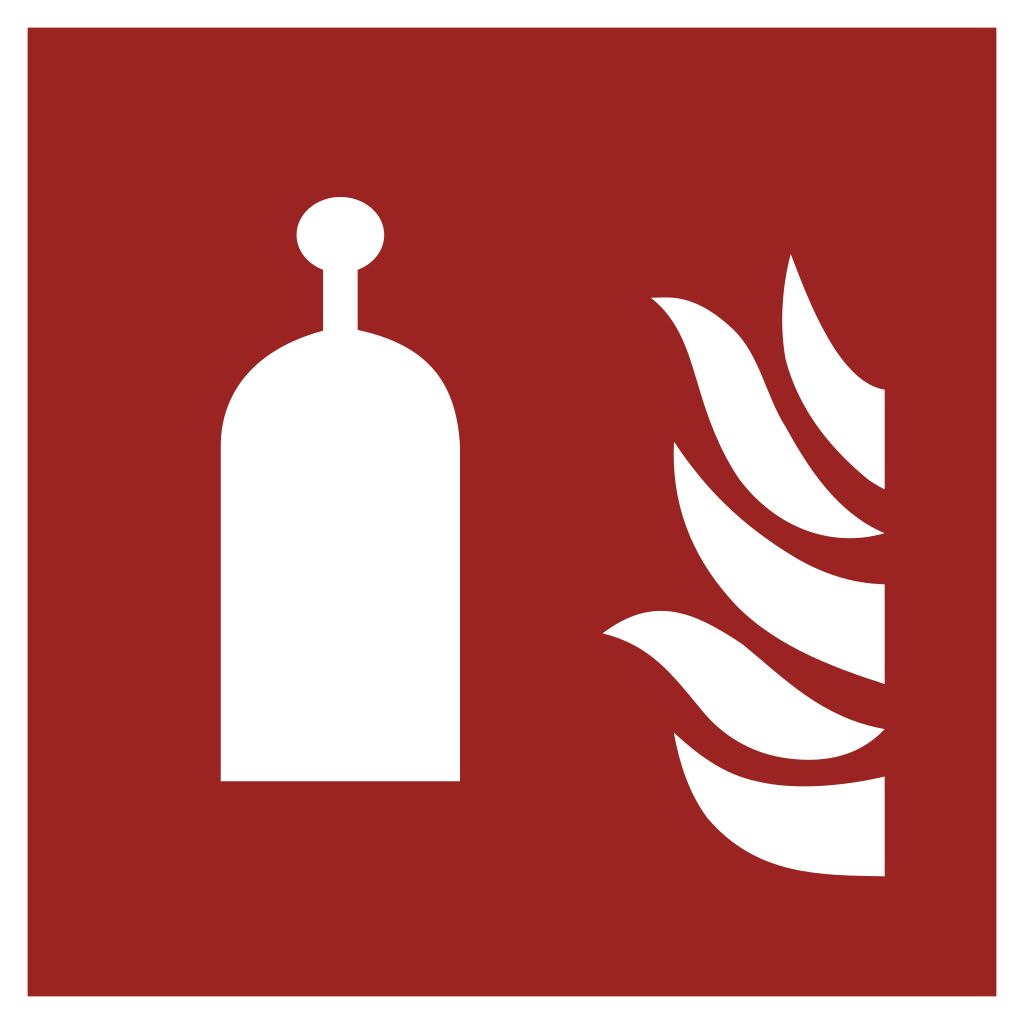
Remote release station
Identifies a remote release station.
Understanding this sign
Red square or rectangular signs identify fire equipment and manual alarm points.
Finding equipment does not mean it is suitable or safe to use. Follow your training and the site emergency procedure.
The Trigger Point of a Fixed System
F014 marks a remote release station: the manual control from which a fixed extinguishing system is discharged into the space it protects, located away from that space. It is the action sign of the fixed-system family — F008, F012, and F013 tell you where hardware sits, but F014 tells the person responsible for the decision where to go to actually release the agent.
Remoteness is the defining feature. Total-flooding systems, above all CO2 systems for machinery spaces and cargo holds, cannot safely be triggered from inside the compartment they flood. The release station therefore sits outside the protected boundary — at a fire control station, outside the engine room entrance, or in a dedicated release cabinet — reachable when the protected space itself is on fire and untenable.
Why the Release Decision Is Procedural, Not Reflexive
Discharging a CO2 flooding system into an occupied space can kill, so the release sequence is deliberately gated. Typical arrangements sound a distinct discharge alarm in the protected space when the release cabinet is opened or the control is armed, and build in a time delay or a two-step operation, so that everyone inside can evacuate before the gas floods in. Confirming the space is evacuated and closed up — ventilation stopped, dampers and doors shut — is part of the drill before the valves are opened.
That procedure is why the station's marking matters so much. In an engine room fire, the master or duty officer must find the correct release point quickly, under stress, possibly in smoke — and equally, an untrained person must not mistake it for an ordinary alarm call point. F014 identifies the station; access control, instructions at the cabinet, and training govern who operates it and how.
Placement, Labeling, and Common Failures
Mount F014 directly at the release cabinet or panel, with directional variants along escape and response routes where the station is not visible from the protected space's exits. Where one location houses releases for several spaces — a fire control station serving engine room, purifier room, and cargo holds — each control needs unambiguous labeling of the space it discharges into, because operating the wrong release wastes the agent and leaves the fire untouched.
The recurring audit findings are predictable: release cabinets blocked by stores, break-glass covers painted over, instruction cards missing or in a language the crew does not read, and signage that survived a refit while the system behind it was rerouted. Since a fixed system usually gets exactly one discharge, the signed release station has to work correctly the first time.
Where you will see F014
On ships and in industrial plants the sign mounts directly at the release cabinet or panel — at a fire control station, outside the engine room entrance, or on a dedicated release cabinet — with directional variants along escape and response routes. Where one station houses releases for several spaces, such as engine room, purifier room, and cargo holds, each control also needs unambiguous labeling of the compartment it discharges into.
Common questions about F014
What is a remote release station for a fire suppression system?
The manual actuation point, located outside the protected space, from which a fixed extinguishing system such as a CO2 flooding installation is discharged. ISO 7010 F014 marks its position so the trained responder can find it when the protected compartment itself is on fire.
Why does CO2 release involve an alarm and a delay?
Because CO2 in extinguishing concentrations is lethal to anyone still inside. Release arrangements typically sound a dedicated discharge alarm in the space and impose a delay or two-step operation, giving occupants time to evacuate before the gas is released. Verifying evacuation and closing the space are part of the release procedure.
Where is the F014 sign placed?
At the release cabinet or control panel itself — outside the protected compartment, often at a fire control station or near the space's entrance — with arrowed variants guiding responders to it. Where several releases share one location, each control also needs a label naming the space it serves.
Can anyone operate a remote release station?
No. Discharge is normally reserved for designated, trained personnel following a defined procedure, since releasing the agent into an occupied or unsealed space is dangerous and the system can usually discharge only once. The F014 sign locates the station; authority to use it comes from the emergency organization, not the sign.
Reference details
| Symbol code | F014 |
|---|---|
| Sign family | ISO Fire Equipment Signs |
| Standard reference | ISO 7010:2019 / ISO 3864-1 ISO Online Browsing Platform: F014 |
| Screen color reference | #FF0000. Screen colors are not a production color specification. |
| Download formats | SVG reference artwork; a 1024 × 1024 pixel PNG conversion on a white canvas. |
| Record date | · How to interpret our dates |
| Page updated |
Choosing a physical sign size
Download dimensions are not installation dimensions. Select sign size, material, placement, and lighting using the applicable standard and the actual viewing conditions. Chemical label sizing follows its own rules. Read the artwork and sizing guide.
Sources and artwork credits
- Artwork source
- Wikimedia Commons file page
- Creator credited by source
- Clemenspool
- License
- CC0
- Source metadata checked
SVG files are local reference copies. PNG files are raster conversions. Check the linked file history and license terms before reuse; a source-metadata check is not certification of the artwork or a workplace installation.
Report a correction to this reference