Wheeled fire extinguisher
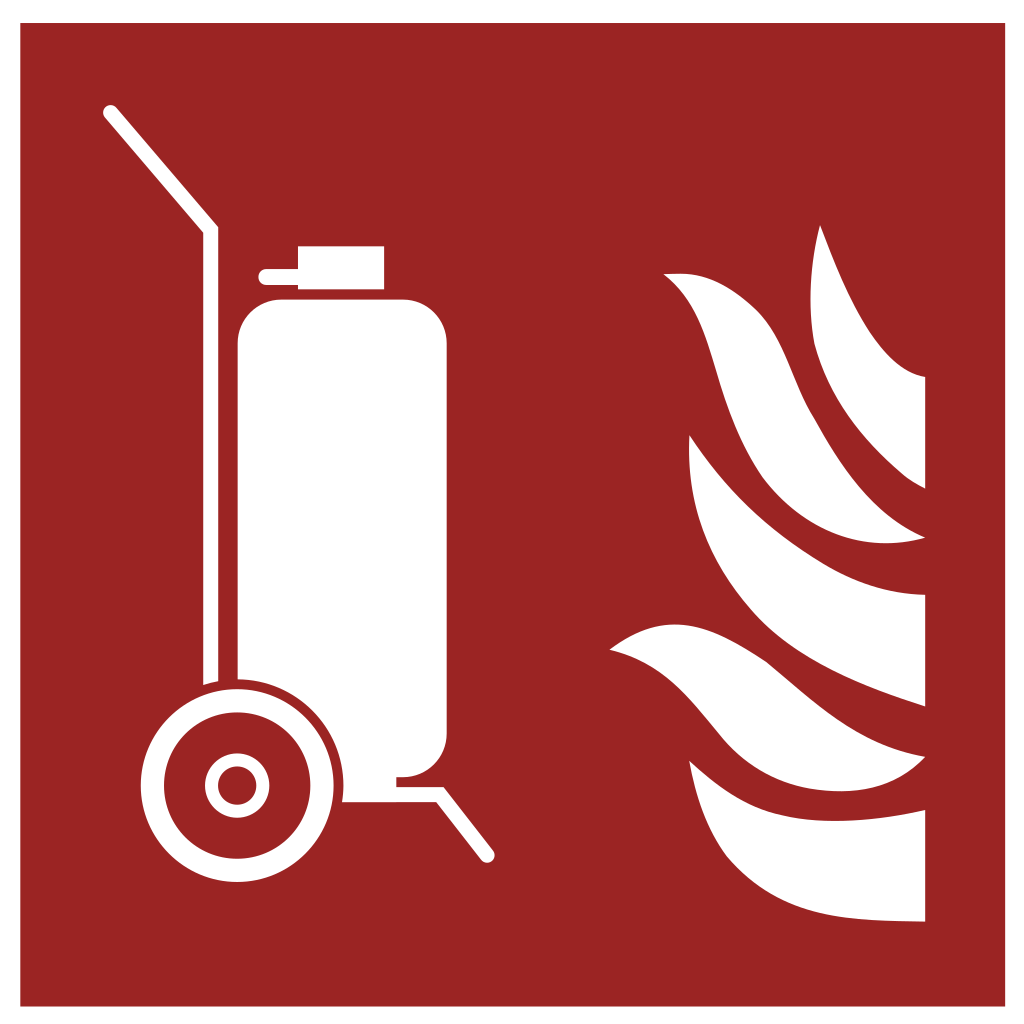
Identifies a wheeled fire extinguisher.
Understanding this sign
Red square or rectangular signs identify fire equipment and manual alarm points.
Finding equipment does not mean it is suitable or safe to use. Follow your training and the site emergency procedure.
A Sign for Big Extinguishers, Not Handheld Ones
F009 marks the position of a wheeled fire extinguisher: a mobile unit with an agent charge far beyond what a person can carry, mounted on a cart with large wheels and a towing handle. Typical units hold tens of kilograms of dry powder, foam solution, or CO2 — enough to attack a fuel spill fire that would exhaust several handheld extinguishers in seconds. The pictogram shows the trolley-mounted cylinder with its wheel, distinguishing it at a glance from the handheld unit on F001.
Because the equipment differs, the response it enables differs too. A wheeled unit is deployed by pulling it to the fire, often over some distance, and its hose gives the operator standoff from radiant heat. Signage that confuses wheeled and portable extinguisher points can leave a responder running to the wrong asset for the fire in front of them.
Where Wheeled Units Are Deployed
Wheeled extinguishers concentrate where a fast-growing flammable liquid fire is credible and hydrant or foam-system coverage may be too slow: aircraft stands and refueling aprons, fuel storage and loading terminals, helidecks and heliports, LPG filling areas, paint and solvent operations, and large workshops handling fuels. Aviation is the classic case — ramp fire points at airports routinely station a wheeled unit precisely because engine and fuel spill fires escalate quickly.
The same logic applies wherever a trained team, rather than a lone bystander, is expected to intervene. Refineries, marine terminals, and motorsport pit lanes position wheeled units at pre-planned fire points chosen during the risk assessment, and the F009 sign lets both the site's own responders and visiting fire crews find them without consulting a plan. Because these sites also carry handheld units, hose reels, and hydrants, consistent use of the correct symbol at each asset is what keeps the fire point legible.
Signing and Siting Wheeled Extinguisher Points
A wheeled unit stands over a meter tall, yet on an open apron or tank farm it still disappears against vehicles, plant, and weather. Mount F009 high on a post, wall, or shelter at each unit's designated station, sized for the long sight lines these open sites involve — the larger sign formats come into their own outdoors. In fuel handling areas, position the station upwind of the likely spill zone where the prevailing wind allows, so the unit can be reached without crossing the hazard.
The station itself needs discipline: a marked keep-clear zone large enough to swing the trolley out, a hard surface it can actually roll on all the way to the credible fire locations, and weather protection for units parked outside. Wheeled extinguishers weigh enough that soft ground, curbs, and stairs effectively delete them from the response. An F009 sign over a unit that is boxed in by parked vehicles or sunk in gravel advertises equipment that cannot be deployed.
Operational Notes That Affect Signage
Deploying a wheeled extinguisher is a trained task. Depending on the model, one or two people maneuver the cart, deploy the hose, and pressurize the unit before discharge, and the agent throw and duration reward technique. Sites therefore treat F009 points as part of the emergency response plan, not as public-use equipment, and some add supplementary text naming the agent and rating so responders pick the right unit for the fuel involved.
Return-to-station discipline closes the loop. After drills, maintenance, or actual use, the unit must come back to the signed position promptly; an empty station under an F009 sign should be treated as a finding in routine fire equipment inspections, the same way a missing handheld unit would be under its own sign. Because a site typically has few wheeled units covering large areas, one unit parked in the wrong place degrades coverage far more than one misplaced handheld extinguisher does.
Where you will see F009
Wheeled units are stationed where fast-growing flammable liquid fires are credible: aircraft stands and refueling aprons, fuel storage and loading terminals, helidecks, LPG filling areas, paint and solvent operations, refineries, marine terminals, and motorsport pit lanes. The sign goes high on a post or shelter at each designated station, sized for long outdoor sightlines, over a marked keep-clear zone with hard surfacing the trolley can actually roll across.
Common questions about F009
What does the F009 wheeled fire extinguisher sign indicate?
It shows where a wheeled (trolley-mounted) fire extinguisher is stationed. These are high-capacity mobile units — commonly tens of kilograms of powder, foam, or CO2 with a discharge hose — meant for larger incipient fires such as fuel spills, and usually operated by trained responders.
Where are wheeled fire extinguishers required or typically used?
At locations with credible flammable liquid or gas fire scenarios and open ground to cover: airport ramps and refueling points, fuel terminals and tank farms, helidecks, LPG stations, and large industrial workshops. Requirements come from the applicable fire code, aviation rules, or the site's fire risk assessment rather than from the sign standard itself.
How is F009 different from the F001 fire extinguisher sign?
F001 marks handheld portable extinguishers; F009 marks wheeled units, and its pictogram shows the cart wheel and towing frame. Keeping the two distinct matters because the equipment, capacity, and expected user differ — a wheeled unit is a response-team asset, not a grab-and-go device.
Can one person operate a wheeled fire extinguisher?
Many models can be moved and operated by one trained person on firm, level ground, but larger units are easier and faster with two — one maneuvering the cart and one handling the hose. Training on the specific model matters more than headcount, which is why sites treat these as designated-responder equipment.
Reference details
| Symbol code | F009 |
|---|---|
| Sign family | ISO Fire Equipment Signs |
| Standard reference | ISO 7010:2019 / ISO 3864-1 ISO Online Browsing Platform: F009 |
| Screen color reference | #FF0000. Screen colors are not a production color specification. |
| Download formats | SVG reference artwork; a 1024 × 1024 pixel PNG conversion on a white canvas. |
| Record date | · How to interpret our dates |
| Page updated |
Choosing a physical sign size
Download dimensions are not installation dimensions. Select sign size, material, placement, and lighting using the applicable standard and the actual viewing conditions. Chemical label sizing follows its own rules. Read the artwork and sizing guide.
Sources and artwork credits
- Artwork source
- Wikimedia Commons file page
- Creator credited by source
- Clemenspool
- License
- CC0
- Source metadata checked
SVG files are local reference copies. PNG files are raster conversions. Check the linked file history and license terms before reuse; a source-metadata check is not certification of the artwork or a workplace installation.
Report a correction to this reference