Fire protection door
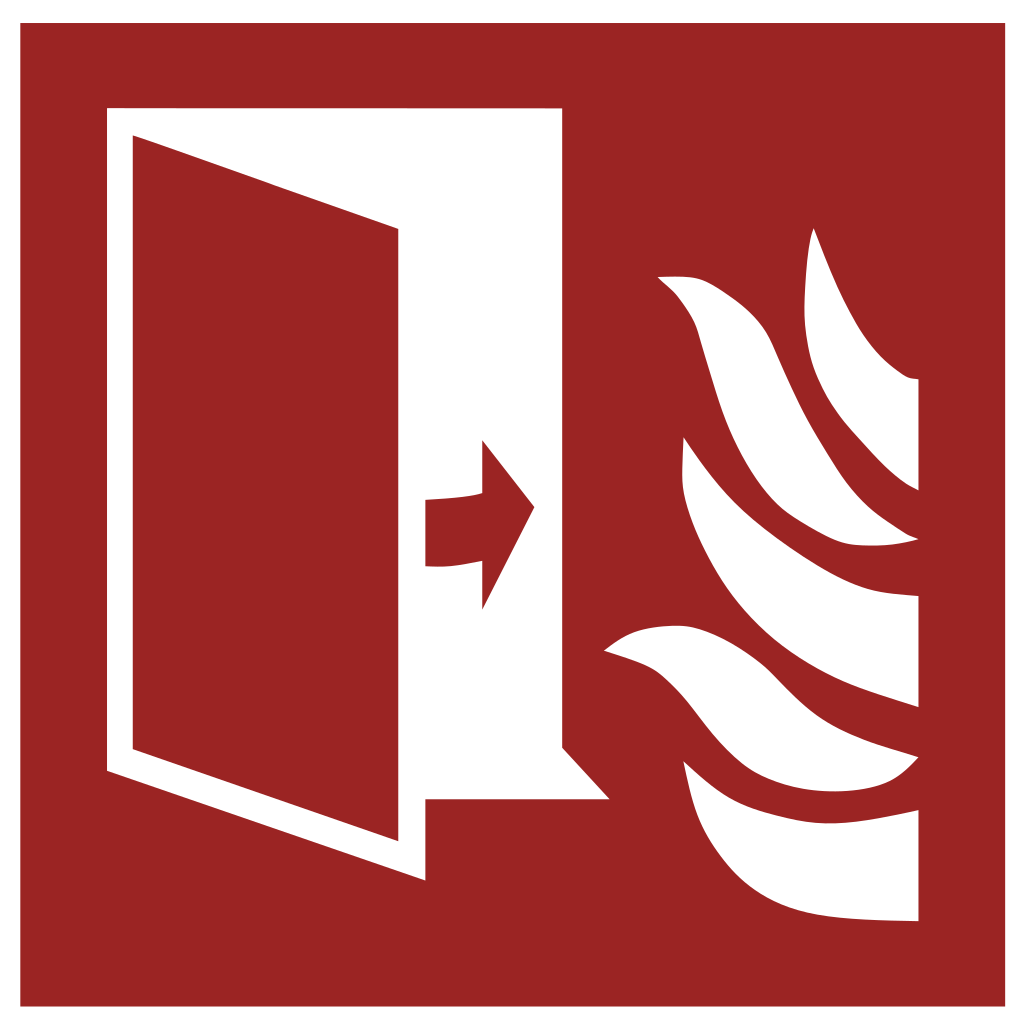
Identifies a fire protection door.

Understanding this sign
Red square or rectangular signs identify fire equipment and manual alarm points.
Finding equipment does not mean it is suitable or safe to use. Follow your training and the site emergency procedure.
What F007 Identifies
F007 marks a fire protection door: a door assembly tested and rated to resist the passage of fire, and in most specifications smoke, for a defined period. The rating belongs to the whole assembly, not the leaf alone — frame, hinges, closer, glazing, intumescent and smoke seals, and even the gap dimensions all contribute, which is why a fire door with the wrong hinges or a planed-down edge can lose its rating without looking any different. The sign tells occupants and inspectors that this particular door is part of the building's passive fire protection.
Passive is the operative word. Fire doors do their work by simply being closed when fire arrives, holding smoke and flame inside a compartment long enough for people to escape and for the fire service to work. Unlike an extinguisher or hose, the door needs nothing from the person passing through it except one behavior: let it close.
Self-Closing, Hold-Open Devices, and the Wedge Problem
Fire doors on escape routes and compartment lines are normally fitted with self-closers, and the universal enemy of the self-closer is the wedge. A wedged fire door is an open hole in a fire compartment wall, and it fails at exactly the moment the compartment is needed. Where a door genuinely must stand open for operations — hospital corridors, kitchen service routes, busy warehouse links — the legitimate solution is an electromagnetic hold-open or free-swing device wired to the fire alarm, which releases the door to close the instant the alarm operates.
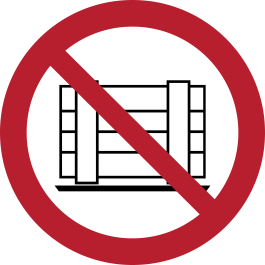
Signage supports the behavior on both faces of the door. F007 identifies the assembly as a fire door; supplementary text such as fire door keep shut, or keep locked for cupboards and risers, states the required condition; and the prohibition sign P023 (do not obstruct) addresses the equally common failure of stock and furniture parked in the door's swing. On automatic hold-open installations the text changes to reflect it, along the lines of automatic fire door, keep clear, close at night where the regime requires.
Inspection and the Sign's Role in It
Fire doors degrade in ordinary service faster than most fire equipment because thousands of people touch them daily. Slammed closers go out of adjustment, seals get painted over or torn out, latches stop engaging, and glazing gets replaced with non-rated panels during refurbishment. Standards practice reflects this: NFPA 80 in North America requires fire door assemblies to be inspected and tested at least annually with deficiencies corrected without delay, and UK guidance calls for routine checks at a frequency matched to traffic, with busy doors looked at as often as weekly.
The F007 sign quietly makes those regimes workable. An inspector, a fire risk assessor, or a duty manager doing a walk-through can only check the doors they can identify, and in an older building the fire-rated doors are not always obvious. A consistent marker on every rated assembly turns fire door inspection from an archaeology exercise into a checklist, and it stops well-meaning maintenance from swapping a rated door or closer for an ordinary one.
Where you will see F007
It identifies rated doors on escape routes and compartment lines in offices, hospitals, hotels, and warehouses, supported by fire-door-keep-shut text and P023 where stock tends to park in the swing. Hospital corridors and kitchen service routes with alarm-linked electromagnetic hold-opens carry adapted wording, and the marker makes NFPA 80 annual inspections workable by making rated assemblies identifiable.
Common questions about F007
What does the F007 fire protection door sign mean?
It identifies a fire-rated door assembly that forms part of the building's compartmentation. The door, frame, closer, seals, and hardware together are designed to hold back fire and smoke for a rated period, and the sign flags the assembly to occupants, maintainers, and inspectors so it is kept closed, unobstructed, and unmodified.
Why can't a fire door be propped open with a wedge?
Because a fire door only protects while it is closed, and a wedge guarantees it will be open when fire or smoke reaches it. If operations demand an open door, fit an electromagnetic hold-open or free-swing device connected to the fire alarm, which releases automatically on activation. Wedging is treated as a serious deficiency in fire safety enforcement.
How often should fire doors be inspected?
NFPA 80 practice in North America is a documented inspection and test at least annually, with repairs made promptly. UK and similar regimes recommend routine checks scaled to usage, from weekly on heavily trafficked doors to quarterly or biannually elsewhere, covering closer operation, seals, gaps, latching, and damage.
Which signs go on a fire door besides F007?
Common companions are text plates stating the required condition, such as fire door keep shut on corridor doors or keep locked shut on riser and cupboard doors, plus the ISO prohibition sign P023 where obstruction by stock or furniture is a realistic risk. Doors on hold-open devices carry text warning that they close automatically on alarm.
Reference details
| Symbol code | F007 |
|---|---|
| Sign family | ISO Fire Equipment Signs |
| Standard reference | ISO 7010:2019 / ISO 3864-1 ISO Online Browsing Platform: F007 |
| Screen color reference | #FF0000. Screen colors are not a production color specification. |
| Download formats | SVG reference artwork; a 1024 × 1024 pixel PNG conversion on a white canvas. |
| Record date | · How to interpret our dates |
| Page updated |
Choosing a physical sign size
Download dimensions are not installation dimensions. Select sign size, material, placement, and lighting using the applicable standard and the actual viewing conditions. Chemical label sizing follows its own rules. Read the artwork and sizing guide.
Sources and artwork credits
- Artwork source
- Wikimedia Commons file page
- Creator credited by source
- SicherheitsPerson
- License
- CC0
- Source metadata checked
SVG files are local reference copies. PNG files are raster conversions. Check the linked file history and license terms before reuse; a source-metadata check is not certification of the artwork or a workplace installation.
Report a correction to this reference